
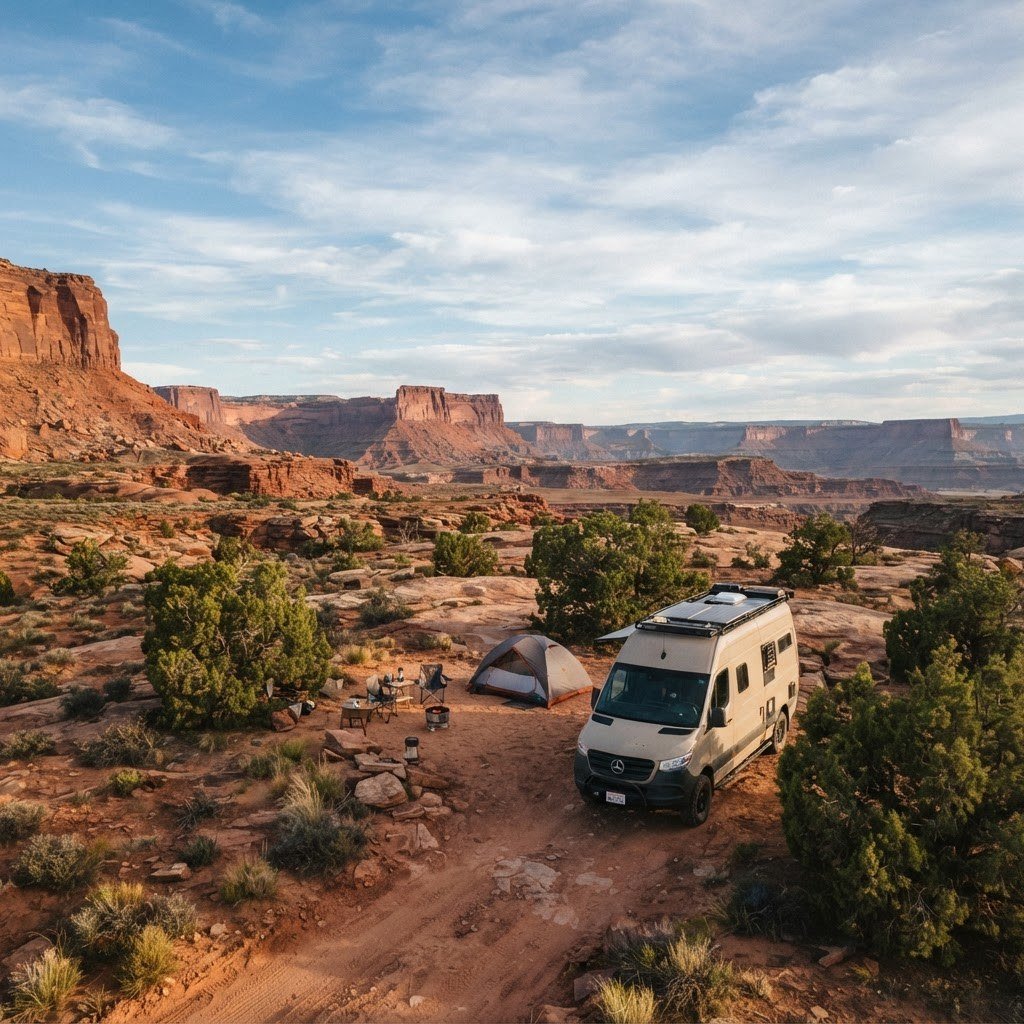
Here’s the question every American naturist eventually asks: the federal government manages hundreds of millions of acres of empty desert, forest, and canyon – can I just camp naked out there? The honest answer is more encouraging than you’d guess, but it depends entirely on where “there” is.
The Federal Baseline: No Nudity Ban
Start with the good news: there is no blanket federal statute or regulation criminalizing simple, non-sexual nudity on Bureau of Land Management land. The BLM’s conduct rules at 43 CFR 8365.1-4 cover nuisances, noise, and waste – not nudity. The same is true of the US Forest Service: the operative regulations at 36 CFR Part 261 prohibit disorderly conduct, and simple nudity doesn’t qualify unless paired with disruptive or obscene behavior.
One myth to kill immediately: you’ll see “36 CFR 843” cited online as a public-lands nudity ban. That regulation doesn’t exist – Parts 800-899 of Title 36 belong to an entirely different agency, and the citation is internet folklore.
How It Actually Works: The Four-Layer Stack
Legality on any given patch of federal land is a stack of rules, checked top to bottom:
- Site-specific closures. Local land managers can – and frequently do – ban nudity at specific spots. BLM field offices issue Supplementary Rules under 43 CFR 8364.1; Forest Supervisors issue Forest Orders under 36 CFR 261.58(e). These orders are most common at popular hot springs, where crowds forced the issue.
- County ordinances. Counties in Arizona, Nevada, and California often have strict public-nudity codes that apply within their lines.
- State criminal law. Under the Assimilative Crimes Act (18 U.S.C. 13), federal officers enforce the law of the state the land sits in. In most states, indecent exposure requires intent to arouse or offend – meaning ordinary skinny-dipping or sunbathing lacks the criminal element.
- The federal baseline. If nothing above applies: no ban.
National Parks are the exception – several NPS units ban nudity outright through compendium rules, so assume “no” inside park boundaries unless a specific tradition exists (California’s Saline Valley being the famous exception).
Where Dispersed Nude Camping Is Safest
- Vermont: The safest state in the country – no state law against simple public nudity at all. The one catch: disrobing in public view is disorderly conduct, so change inside your tent.
- Oregon: Simple nudity is protected expression under the state constitution (State v. Henry). Remote BLM and Forest Service land here is as legally secure as it gets.
- New York: Top-freedom is legal for women statewide (People v. Santorelli), a unique status in the country.
- Hawaii and Ohio: Statutes require sexual intent, leaving room for remote, private skinny-dipping.
Practical Rules for Boondocking Naked
- Choose seclusion deliberately. Dispersed camping in a canyon bottom far from roads is a different legal and social situation than a pullout on a scenic byway. Visibility from a public road is the usual trigger for complaints.
- Check for closure orders before you go. Search the field office or forest’s website for “supplementary rules” or “forest orders” – they name their bans publicly.
- Respect hot spring etiquette. Remote springs often run clothing-optional by long custom; developed and family-visited springs almost always have a written ban. Ask, look for signs, and yield to the group already there.
- Keep it non-sexual and low-impact. The moment nudity becomes sexual or intrusive, every layer of the stack turns against you.
The system rewards remoteness: the farther you are from an unwilling audience, the more every layer of law tends toward your side. Combine this knowledge with our guides to Burning Man (the largest legally nude city on BLM land), Vermont’s legal lakes, and Oregon’s official clothing-optional beaches.
Flying in? Compare flights on Kayak to plan the trip. Disclosure: affiliate link – we may earn a commission at no extra cost to you.
Where to Stay
Find accommodation near the naturist zone on the map below:
Disclosure: this map contains affiliate booking links. If you book through it, we may earn a commission at no extra cost to you.

Leave a Reply