
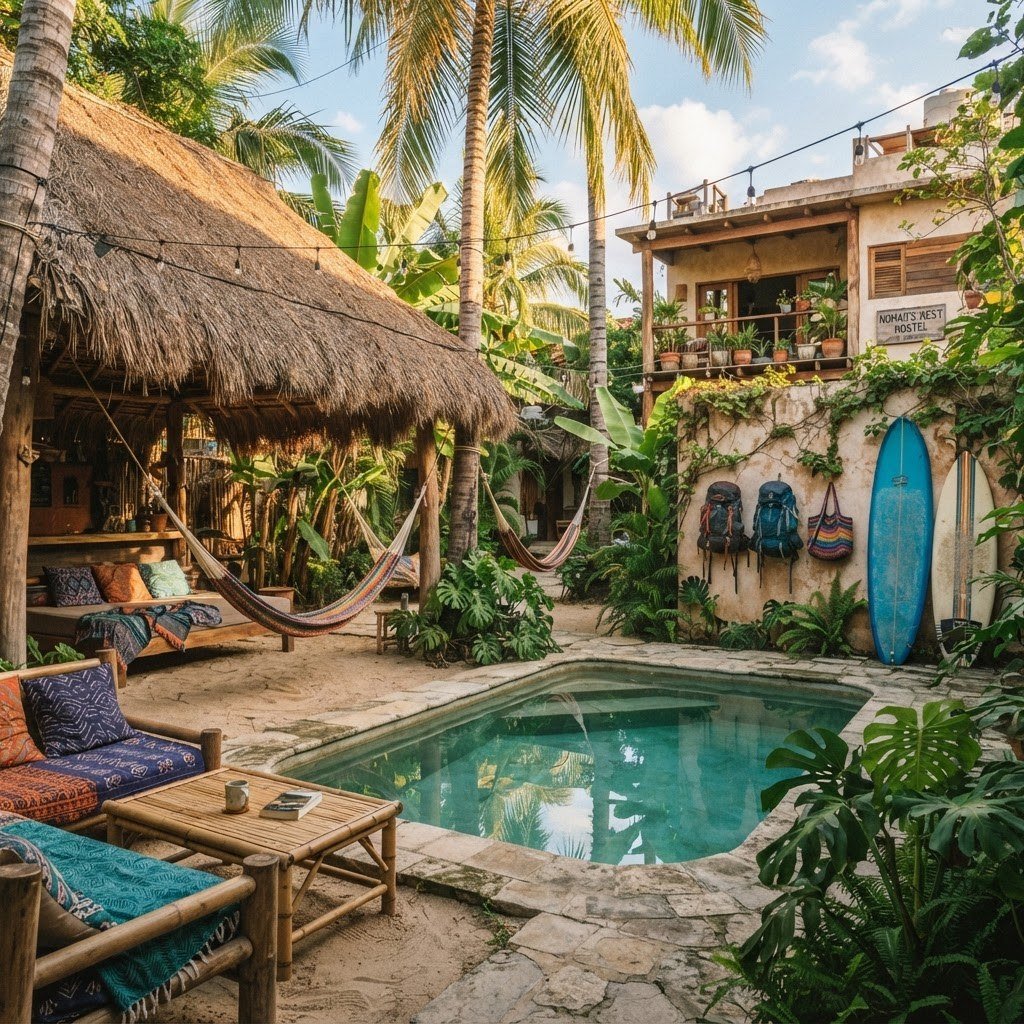
Ask the internet for a nude hostel and you will mostly find myths. The honest structural answer is that commercial naturist hostels with shared clothing-free dormitories essentially do not exist – insurance underwriters refuse them, hostel licensing collides with adult-use zoning, and naturism’s strict non-sexual etiquette is operationally unmanageable in a high-turnover ten-bed dorm that skews heavily male. But the budget naturist ecosystem is real and worldwide, it simply evolved along different rails: member-owned clubs built on cheap camping instead of bunks, family-run pousadas and farmstays priced for backpackers, work-exchange placements, and a young clothing-optional coliving movement now being built by digital nomads. This is the definitive map of all of it, with the one Mexican beach town where true nude hostels actually exist.
The World’s Only True Nude Hostels: Zipolite, Mexico
The single place on Earth where the backpacker model and naturism genuinely merged is Playa Zipolite, Mexico’s officially clothing-optional beach town (our full guide). Casa Nudista, two minutes from the sand, is the world’s flagship nude hostel: mixed dorm beds at $25 to $35 with nudity mandatory in every common area – pool, courtyard, bar – and an active work-exchange program through Workaway and Worldpackers. Che Zipolite runs beachfront dorms from $18 with clothing-optional pool and terrace zones; Hotel Zipoliteville (opened 2023) mandates nudity across its communal areas from $25; Posada México and Hostal La Loma offer rustic rooms and hammock spaces from $15. The whole-town reality matters: nudity is legal and normalized on the entire 1.5 kilometer beach and at beachfront palapa bars, required to wrap up on the streets. With $2 tacos and $1.50 beers, a backpacker lives in Zipolite for $30-45 a day all-in.

Europe: Camping Is King
Over ninety percent of European budget naturism runs on tent and van pitches at federation-affiliated sites, from €12 to €28 a night. France anchors the system: CHM Montalivet – the world’s first naturist resort, born 1950 – pitches from €15 with dedicated youth and solo-traveler tent fields beside the central plaza and beach bars; Euronat and Arnaoutchot run the same Atlantic coast at €16-28 floors, and the FFN’s network of gîtes and chambres d’hôtes puts private naturist homes at €45-75 with pool and communal breakfast. Germany’s FKK camping network (Rätzsee in the Mecklenburg lakes from €12, Baltic Rosenfelder Strand, club grounds like Freiburg’s Sonnland accepting INF cardholders) is the continent’s cheapest rail. Croatia confirms the rule and the exception: world-class naturist resort camping at Koversada, Solaris and Valalta from €20-42 – with zero budget guesthouses, the country’s naturist market is camping, full stop. Spain‘s best value is off-season self-catering in the Vera Playa urbanización, €35-65 a night or €450-700 monthly, plus Costa Natura on the Costa del Sol. Portugal hides the continent’s single cheapest bed: Quinta do Maral in the Serra de São Mamede charges €5-7.50 per person with a communal kitchen, campfire and a genuinely nomad-friendly community. Greece offers the free option – wild camping at Glyka Nera, Crete’s boat-access sweetwater beach – against Vritomartis’s off-season half-board value. Britain runs its sun clubs: Spielplatz (the UK’s oldest naturist village, 1929), Broadland Sun Association and the Naturist Foundation’s 50-acre Orpington grounds, pitches at £15-30. The Netherlands’ NFN network, Belgium’s Camping Athena, Austria’s lake-side Sabotnik, Swiss Die Neue Zeit and Sweden’s Solvik complete the belt at €14-26 floors. One honest hybrid: northern Europe’s hostels don’t permit nudity in dorms, but Berlin hostels feed guests to textile-free complexes like Vabali and Liquidrom, and Finnish budget hostels run traditional nude saunas on site.
The Coliving Frontier
The clothing-optional coliving movement exists, and it lives in the mountains of Andalucía. Resonancia, a four-story residence in the Alpujarra village of Yátor, is the flagship experiment: clothing-optional coliving and coworking with high-speed fiber, shared and private rooms from roughly $415 a week or $1,200-1,600 monthly, built around conscious-community living and body-positive workshops. Portugal’s Algarve and Alentejo host informal nomad pop-ups – WhatsApp-networked rural quintas at €25-45 a night or €500-800 monthly – rather than branded operations. The deeper models are older: Colina do Sol in southern Brazil is the Southern Hemisphere’s largest intentional naturist village, where members buy plots and build homes alongside rental bungalows and camping; Germany’s FKK Dauercamping system has members holding long-term leases on club plots with permanent chalets for a century. The lesson for digital nomads: naturist coliving is emerging as ecovillage-scale community, not urban coworking.
The Americas
The United States has zero commercial naturist hostels or coliving buildings – the workaround is the AANR club network. Serendipity Park (Georgia) tents from about $45-60 all-in; DeAnza Springs (California high desert) dry-camps at $45 with a workamper program trading 15-20 hours a week for a full RV site; Lupin Lodge (Santa Cruz mountains) and Cedar Creek (South Carolina) sit in the same bracket. Mira Vista (Tucson) starts at casita prices. On Hawaii’s Big Island, Kalani – the legendary retreat that survived the 2018 Kilauea eruption next door – has restructured from its 100-volunteer era into targeted residencies, keeping the clothing-optional pool at $20 a day and lodge rooms from about $100. Brazil is the budget champion of the Americas. Colina do Sol’s camping floor is $10-16 a night; Praia do Pinho’s campground charges $8-12 with pousada rooms from $34; the Massarandupió coast’s Camping Eco Parque da Mata offers genuine naturist hostel dorm bunks at $14-20 – one of the only ones outside Zipolite – and Barra Seca’s rustic river-crossing campground runs $7-10. The Caribbean is honest-zero territory: Paya Bay on Roatán, the region’s naturist anchor, is a boutique resort from $160 with no dorms, and Costa Rica’s Penal Code Article 376 keeps the mainland at absolute zero.
Asia-Pacific
Thailand’s naturist resort network is the region’s answer to budget travel – no dorms exist, but private-room price floors land squarely in hostel territory. Dragonfly Naturist Village near Pattaya runs $35-45 weekday rates including breakfast, pool and bathhouse; Barefeet (Bangkok) from $50; Tao Life Center’s rustic Chiang Dao bungalows were the cheapest at $20-35 before its recent sale listing; longstay discounts of 15-35% and Naturist Association Thailand membership (10% reciprocal discounts, annual NATCON gathering) make a month at a Thai naturist resort genuinely affordable. Bali au Naturel (north coast, Bondalem) bungalows start at $35-55, and Indonesian budget naturists pool villas via NaturistBnB at $40-70 split between travelers. New Zealand runs the farmstay tradition: Pineglades (Christchurch) pitches from $12-22 and clubhouse rooms from $30, Katikati Naturist Park $18-28, Taranaki’s member-hosted chalets – all listed through the NZNF directory. Australia is club territory ($13-23 camping at Sun Eden, Pine Trees and Wallaringa), with a critical market update: K2 River Island, the country’s largest commercial clothing-optional retreat, has transitioned to a standard clothed campground, leaving the non-profit clubs as the budget naturist’s only Australian option.
Platforms, Work-Exchange and the Budget Blueprint
NaturistBnB is the booking platform that works: roughly a thousand global listings including private rooms, entire homes, 36 campsites and a handful of dorm-tagged homestays, €25-150 a night. Airbnb and Vrbo yield results under the keywords naturist, clothing-optional and FKK; Facebook’s naturist housesitting and hospitality-exchange groups run the informal layer. Work-exchange is the deepest budget cut of all: an estimated 80-150 clothing-optional listings live across Workaway, Worldpackers, HelpX and WWOOF at any time – Zipolite’s hostels, Provence and Andalusia campsites, Sun Eden in South Africa – trading 20-25 hours a week for a bed, meals and full resort access, with volunteers adopting the site’s nudity policy and its zero-tolerance etiquette. The blueprint for a month of clothes-free travel on a backpacker budget: an INF passport card, which pays for itself in three or four nights of federation pitch discounts; a tent; the shoulder season; and either a Thai resort longstay, a Portuguese quinta, or a work-trade bunk in Zipolite.
Where to Stay
Disclosure: this map contains affiliate booking links. If you book through it, we may earn a commission at no extra cost to you.
Leave a Reply