
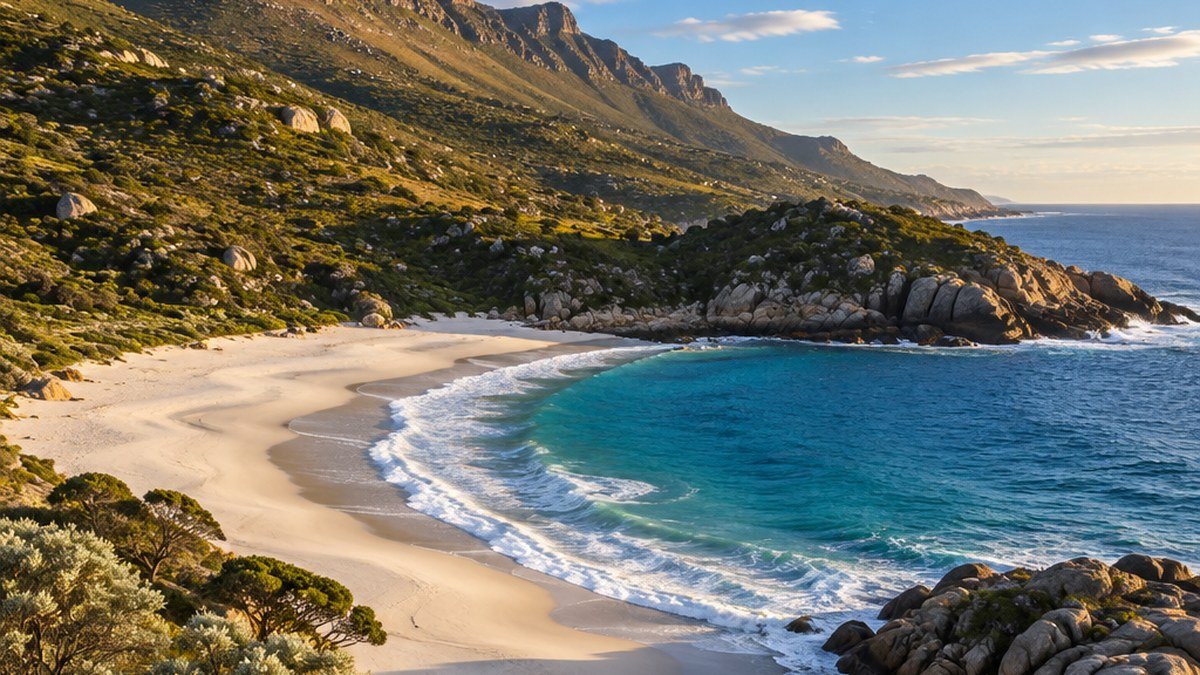
Sandy Bay, the secluded cove between Llandudno and Hout Bay that has served as Cape Town’s unofficial nude beach for more than half a century, now has an official message for anyone planning to arrive without clothes. In September 2026, new signs went up at both entrances to the beach stating that “nudity and/or sexual misconduct” is prohibited in public spaces, “including the beaches and pathways.” The signs warn that fines may be issued and that the area is under surveillance, including by drones.
For naturists, the wording is the problem: nudity has been bundled into the same prohibition as sexual misconduct, at a beach where the two have never been the same thing. Here is what the signs say, what the law behind them does and does not settle, and what it means in practice if you are travelling to Cape Town this summer.
What the new Sandy Bay signs say
The signage went up at both entrances to the bay in the third week of September 2026, ending a legal review that South African National Parks (SANParks) said in March was still under way. It prohibits “no nudity and/or sexual misconduct in any public space, including the beaches and pathways,” cites fines under Section 19 of the Sexual Offences Act, and states that the area is monitored, drones included.
The signs were funded by the Llandudno City Improvement District and residents of nearby Kronenzicht, with support from SANParks and local councillor Cameron Patrick. They arrived ahead of further joint operations involving SANParks, the police, City Law Enforcement, Metro Police and private security, as Cape Town heads into summer.
Why SANParks says the beach was never naturist
SANParks set out its position in March 2026, in a written response to CapeTalk: Sandy Bay forms part of Table Mountain National Park and “is not, and has not been, formally designated as a naturist beach.” The agency added that nude sunbathing is not permitted there and that rangers had not been instructed to target naturists, describing patrols as routine compliance work.
That is accurate on the narrow point: Sandy Bay has never been gazetted as clothing-optional. In South Africa a beach only becomes legally nude when a municipality passes a bylaw and publishes it, and no Cape Town administration ever has. The country’s one attempt, a stretch of the Mpenjati estuary in KwaZulu-Natal, was approved locally in 2015 and then collapsed under provincial and legal objections. As things stand, South Africa has zero legally designated nude beaches along roughly 3,000 kilometres of coastline.
What SANParks’ statement leaves out is that the absence of a bylaw never meant an absence of naturism. A City of Cape Town beach guide published in 2009 described Sandy Bay as “Cape Town’s unofficial nudist beach.” The area’s naturist history runs back to the 1960s, through police raids in the 1970s and two court cases in the 1980s. Our own complete guide to naturism in South Africa has long flagged Sandy Bay as the country’s most contested patch of sand for exactly this reason: tradition without statute.
The legal question the signs do not answer
Section 19 of the Sexual Offences Act of 1957 does not say the word “nude.” It makes it an offence for an adult to exhibit themselves in an “indecent dress or manner” in a place accessible to the public. Whether peaceful nude sunbathing at a secluded beach qualifies as indecent is a question of fact, not of signage, and South African courts have looked at it before.
Naturist histories point to two Cape Provincial Division cases from the 1980s, S v Schultz and S v King, both concerning nudity at Sandy Bay. In the first, a conviction was reportedly overturned after the state failed to prove that non-sexual nudity was indecent; in the second, a woman tanning nude in a secluded part of the beach was reportedly acquitted. The original judgments are hard to find in online legal archives, so their present-day weight is genuinely uncertain, but they cut against the assumption that simple nudity at Sandy Bay is automatically criminal. That gap between what the signs imply and what the law establishes is the crux of the dispute.
What naturists are asking for, and what residents are worried about
Marthinus Pretorius, a long-time campaigner for formal recognition of the beach, told CapeTalk that he, the South African Naturist Association (SANA) and the Western Cape Naturist Association (WCNA) were preparing formal correspondence to SANParks, the City of Cape Town and CapeNature. His request is narrow: explain the legal position and consult before enforcing it. He has also offered something unusual, that naturists help police the beach themselves, with volunteers accredited so they can address unlawful behaviour on site.
A local resident interviewed by CapeTalk, Tanya, made a distinction that gets lost in the signage. She said she does not object to naturism at all, only to sexual activity in the dunes and among the rocks, and that she no longer feels comfortable bringing children to the beach. Several naturists have said the same thing from the other direction: harassment, voyeurism and non-consensual photography are the real problems, and they are not caused by the absence of swimwear.
A Change.org petition launched in March 2026 asks the City of Cape Town to designate Sandy Bay as a regulated naturist beach with a clear code of conduct. By late September it had passed 2,500 signatures. That framing, regulation rather than prohibition, is the one most likely to satisfy both sides: explicit rules on conduct, explicit boundaries, and enforcement that targets behaviour instead of bodies.
Is anyone actually being fined?
As of publication, there are no confirmed reports of a visitor being fined for nude sunbathing at Sandy Bay. The signs are in place, the joint operations were announced, and the legal review behind the wording has not been published. Naturist organisations have not announced a court challenge. In practical terms that leaves a beach with a clear written prohibition, unproven enforcement, and an unresolved legal basis: a genuinely uncomfortable position for a traveller deciding what to pack.
If you are going to Cape Town this summer
Getting there. Sandy Bay has no direct vehicle access. You park on the residential streets above Llandudno, near the Sandy Bay Road trailhead, and walk down. It is 20 to 30 minutes of uneven path to the sand, and the climb back up is steeper than it looks in the heat. A small trailer at the parking area sells water and soft drinks; that is the last of any commercial anything.
On the beach. There are no facilities, no lifeguards and no shade. The Atlantic here is cold, typically in the mid-teens Celsius, with a shore break that deserves respect. Carry out everything you carry in, bring more water than you think you need, and note that the nudist section has traditionally been the far end of the bay rather than the whole beach. Standard naturist etiquette applies and matters more than usual right now: towel down, no photography of anyone, no lingering, and zero tolerance for anything that could reasonably be read as sexual conduct.
Best time. November to March is Cape Town’s dry summer, with the most reliable beach weather from December through February. Mornings are calmer and the south-easter tends to build through the afternoon. Weekdays are quieter than weekends and public holidays.
Where to stay. There is no naturist resort in Cape Town, so the practical base is self-catering in Llandudno, Hout Bay or further along the Atlantic Seaboard. A small number of naturist-friendly flats and guesthouses operate in the Hout Bay area. If your trip depends on reliable, fully legal clothes-free time, the honest answer for South Africa is inland: the bushveld cluster of naturist game farms and resorts north of Pretoria and around the Waterberg is where South African naturism actually works, with zebras on the lawn and no ambiguity about the dress code.
What this means beyond one beach
Sandy Bay is not an isolated local argument. It is the same collision between long custom and written law that has played out at Colombian coves everyone calls nude beaches but no authority recognises, at Montenegrin beaches whose protected status outranks their naturist history, and in New Zealand, where clothing-optional access was won in court rather than granted by bylaw. The privacy dimension deserves its own line, too: a beach already troubled by non-consensual photography now sits under surveillance that includes drones, with no published policy on whether footage is recorded, retained or who can access it, the same issue raised by wearable cameras everywhere in our analysis of smart glasses on nude beaches.
The bottom line
Sandy Bay is still there, still beautiful, still hard to reach, and still the most famous unofficial nude beach in Africa. What changed in September 2026 is that the tolerance it ran on for fifty years is now in writing against it, backed by a statute that does not clearly say what the signs say. Naturist organisations are asking for consultation rather than confrontation; residents are asking for safety rather than censorship; those two goals are compatible. Until someone publishes the legal reasoning or a court rules, treat Sandy Bay as a beach where clothing is advisable and enforcement is possible, and watch the wider African naturist map, which is unlikely to stay quiet.
Sources
Cape Argus / IOL and EWN / CapeTalk, 21 September 2026; EWN, 13 March 2026; Sentinel News, 25 September 2026; SAPeople and 2oceansvibe, 22 September 2026; Planet Nude, 24 September 2026; City of Cape Town 2009 beach guide; Change.org petition to regulate Sandy Bay as a nudist beach.
Leave a Reply