
Portugal is quietly one of the best naturist destinations in Europe. It is one of the few countries with an actual legal framework for naturist beaches: nine stretches of sand are officially designated by municipal decree, with signs posted at the boundaries, and a national federation, the Federação Portuguesa de Naturismo, keeps the registry. Beyond the official list, naturism is quietly tolerated on dozens of secluded beaches from the Silver Coast to the Azores.
This guide covers the whole country: the legal picture, all nine official beaches, the best tolerated spots, the islands, naturist accommodations, and how to reach the flagship, Praia da Bela Vista near Lisbon, without a car.
How Naturism Works Under Portuguese Law
Portugal took naturism seriously enough to legislate it. Designation happens through municipal assemblies working with coastal management plans (the POOC and POC plans), and an official naturist zone must be marked with signage starting 100 meters before the beach. The nine official beaches are all south of the Tejo estuary, in the Setúbal, Alentejo and Algarve regions.
Outside those zones, simple non-sexual public nudity is not itself a crime. Article 170 of the Penal Code targets sexual harassment and exhibitionist acts directed at other people, not a quiet day at a secluded cove. In practice, naturism on traditionally tolerated beaches is left alone unless someone complains, and the maritime police can issue warnings on busy textile beaches. The rule of thumb: at an official beach you are on solid legal ground; anywhere else, keep to genuinely secluded areas and use judgment.
Praia da Bela Vista: Lisbon’s Official Naturist Beach
The easiest gateway to Portuguese naturism is Praia da Bela Vista, in Almada on the Costa da Caparica, about 25 to 30 kilometers south of central Lisbon. Designated in 1995, it was one of the first two official naturist beaches in the country, and it remains the most accessible from the capital.
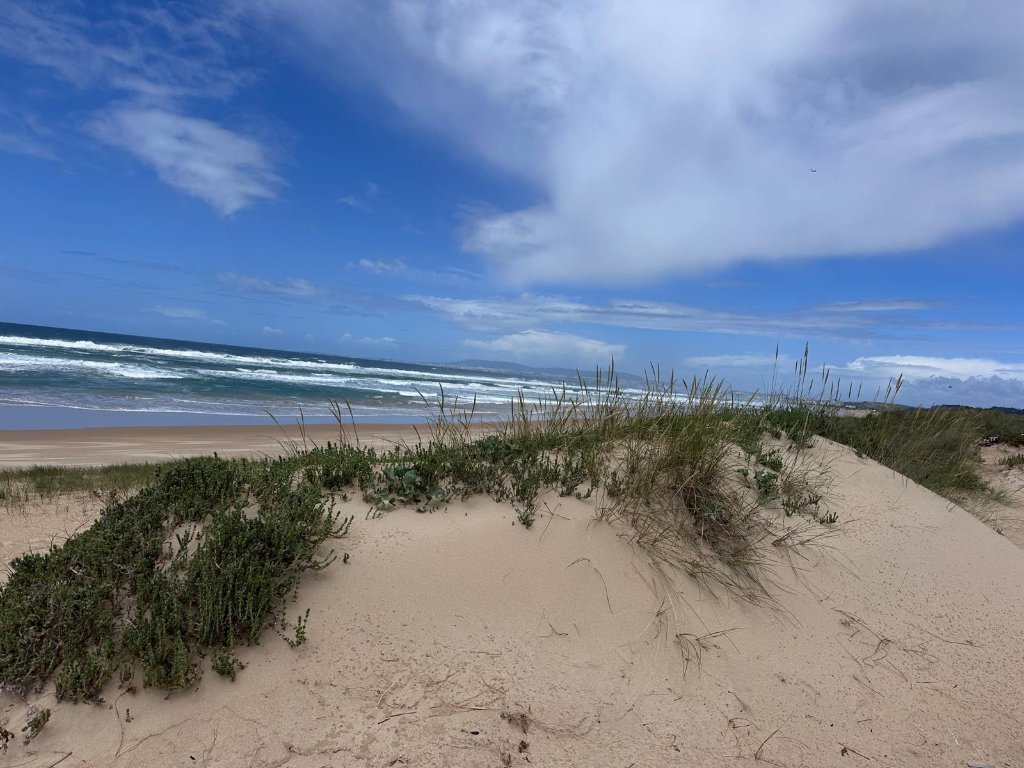
The layout matters. The main entrance, near the Waikiki restaurant, is a regular textile beach with a lifeguard during the June-to-September season. Walk 100 to 200 meters south along the sand and you cross into the naturist zone, which stretches down toward the dunes and the wilder, more remote stretches beyond. The far southern end, known internationally as “Beach 19,” is famous as one of Europe’s great gay naturist beaches; the northern part of the zone draws a mixed crowd of couples, women and longtime naturists.
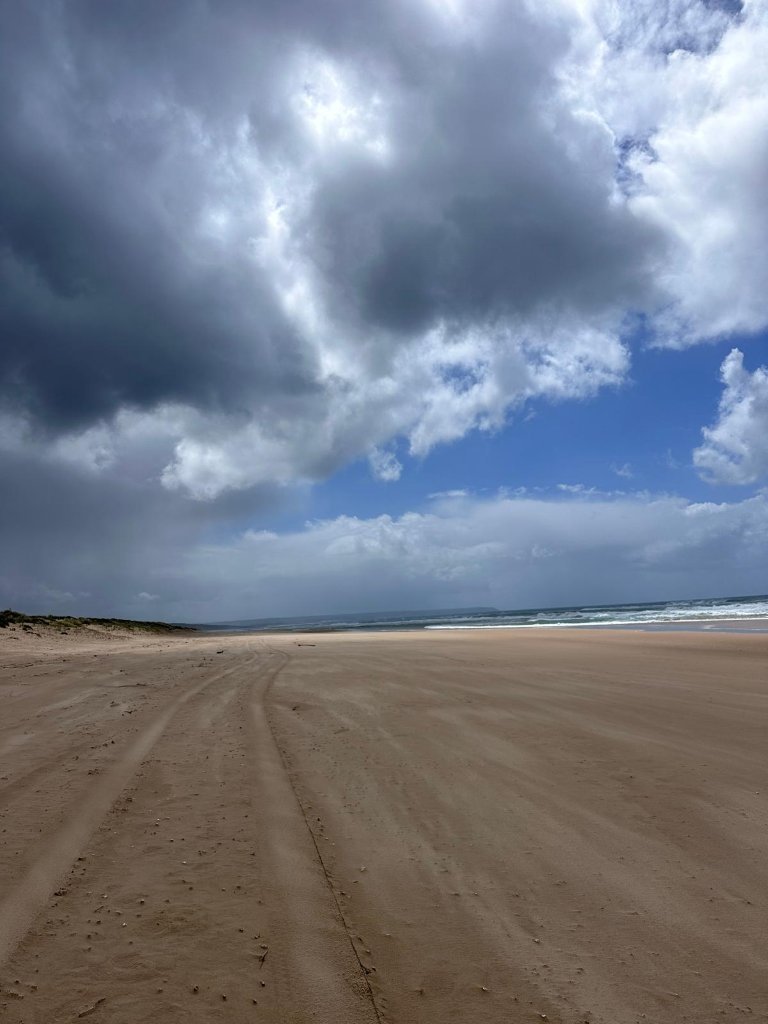
On the sand at Praia da Bela Vista: wide open beach, Atlantic surf, and not a crowd in sight.
There are no facilities inside the naturist zone itself, so bring water, sunscreen and everything you need for the day. The Atlantic here is brisk even in August, with strong rip currents and shorebreak, and the afternoon nortada wind is a daily fact of life. Use the boardwalk paths through the dunes; the dune system is protected.
Getting to Praia da Bela Vista Without a Car
- Bus from Lisbon: Carris Metropolitana route 3710 runs from Sete Rios in Lisbon to the Costa da Caparica terminal.
- Ferry plus bus: Take the ferry from Cais do Sodré across the Tejo to Cacilhas, then routes 3012, 3021 or 3025 to Costa da Caparica.
- From Caparica: Feeder routes 3030 or 3705 run south along the coast toward Fonte da Telha, which serves Bela Vista and the coast beyond.
- By car: Cross the 25 de Abril bridge and follow the coast road to the parking lots near Praia do Rei or Praia da Mata, then walk 10 to 15 minutes south along the dune path.
One practical note: the little Transpraia beach train that once trundled along the dunes has been suspended since 2020, so do not count on it. Check current timetables on the Carris Metropolitana site before you go, as routes do change.
The Other Official Beaches Near Lisbon
Praia do Meco (Praia do Moinho de Baixo), Sesimbra. Portugal’s pioneer. Naturists gathered at Meco long before anyone made it legal, and the southern half of the beach is the designated naturist zone. The crowd is famously relaxed and bohemian, a mix of veteran naturists, couples and families. Facilities sit at the textile north end; the naturist section has none. Continue walking south and you reach wild Praia do Rio da Prata, where bathers have long painted themselves in the natural clay that trickles down the cliffs.
Praia da Adiça, Almada. At the southern end of the Caparica coast, designated in 2015, Adiça is a 1.5-kilometer wild stretch south of the fishing village of Fonte da Telha. No facilities, no lifeguards, and a very traditional naturist crowd that prizes its tranquility. Keep clear of the fossil cliffs at the back of the beach.
Alentejo and the Costa Vicentina
The wild southwest is where Portugal’s naturist beaches get beautiful. Praia do Salto at Porto Covo (designated 2002) is an intimate cliff-ringed cove. Praia dos Alteirinhos at Zambujeira do Mar (2008) has the naturist zone in its southern area, reached by stairs down the cliff. Praia do Malhão Norte near Vila Nova de Milfontes (2019, the newest designation) is a broad dune-backed expanse. All are remote, unspoiled and quiet even in July.
The Algarve’s Official Beaches
- Praia das Adegas, Odeceixe: a sheltered little cove just south of Odeceixe’s main beach, reached by wooden steps. Right on the Costa Vicentina border, so you get wild Atlantic scenery rather than resort Algarve.
- Praia do Homem Nu, Tavira: on Ilha de Tavira, a walk of roughly 1.5 to 2 kilometers west from Praia do Barril, past the famous Anchor Cemetery, into dunes and emptiness. The name, “Naked Man Beach,” is very literal.
- Praia da Barreta (Ilha Deserta), Faro: on the uninhabited barrier island in the Ria Formosa, reached by boat from Faro. Europe’s southernmost-feeling naturist escape: one restaurant, one ferry, and a lot of sand.
Two tolerated Algarve coves are also naturist favorites: Praia de João de Arens near Portimão and Praia das Furnas near Salema.
Tolerated Beaches in Central and Northern Portugal
There are no official naturist beaches north of the Tejo, but the FPN maintains a tolerated list, and these stretches have long naturist traditions: Praia do Salgado near Nazaré (practice concentrated north of the dune car park), Praia de Almagreira just north of Baleal on the Peniche coast, Praia da Gralha near São Martinho do Porto, Praia da Cambelas north of Santa Cruz, Praia do Rodanho south of Viana do Castelo, and Praia da Estela near Póvoa de Varzim. The drill is the same everywhere: walk away from the main access, find the secluded stretch, and use discretion.
The Azores and Madeira
Neither island region has any officially designated naturist beach, and there is no naturist infrastructure there, no clubs, no naturist accommodations. What the islands offer instead is remoteness. In the Azores, Praia da Amora on São Miguel, black volcanic sand under steep cliffs, is the most established tolerated spot. In Madeira, Praia da Atalaia below Caniço de Baixo and the extremely isolated Calhau da Lapa are the known options, while on Porto Santo the far southwestern end of the nine-kilometer golden beach near Ponta da Calheta sees discreet nude sunbathing well away from the resort zone. None of these have lifeguards, most require steep descents, and the Atlantic is cold outside late summer, but you will have the place to yourself.
Naturist Places to Stay
- Monte Naturista O Barão (Santiago do Cacém, Alentejo): the country’s flagship naturist resort, a 7-hectare domain with a saltwater pool, chalets, camping, bar and sauna. Open year-round.
- Villa Paraiso (Porches, Algarve): an adults-only naturist boutique B&B with four rooms, a jacuzzi pool and a private garden.
- Quinta do Maral (Marvão, Alto Alentejo): naturist camping and glamping in the Serra de São Mamede natural park, roughly May to October.
- Terra Nua (Messejana, Alentejo): a small, quiet naturist campsite with a pool, open spring to autumn.
- NaturViana (Viana do Castelo): yurts and eco-camping with an outdoor pool, the north’s naturist option.
Etiquette and Practical Tips
- Always sit on a towel, and dress before walking back to beach bars, concessions or textile sections.
- Never photograph other people. Photography without explicit permission is the fastest way to make enemies on any naturist beach.
- Respect zone boundaries. At official beaches, the designation covers the marked stretch only.
- Know the water: the Atlantic west coast runs 15 to 20°C even in summer; the eastern Algarve is milder, 20 to 23°C in late summer. Expect rip currents everywhere.
- Watch the cliffs: many naturist coves sit under unstable sea cliffs. Set up well away from overhangs.
- Season: June through September for lifeguards, beach bars and warm weather; May and October for quiet and variable conditions. Naturist resorts and campsite seasons vary.
Flying in? Lisbon (LIS) is the natural gateway for Bela Vista, Adiça and Meco, while Faro (FAO) serves the Algarve’s naturist beaches. Search and compare fares on Kayak. Disclosure: affiliate link – if you book through it, we may earn a commission at no extra cost to you.
Where to Stay for Praia da Bela Vista and the Lisbon Coast
Lisbon makes the perfect naturist base: city in the evenings, Bela Vista, Adiça and Meco by day. The map below is centered on Praia da Bela Vista so you can compare stays in Almada, Costa da Caparica and the city itself:
Disclosure: this map contains affiliate booking links. If you book through it, we may earn a commission at no extra cost to you.
Leave a Reply