
Réunion Island is the odd one out of the Indian Ocean. Its neighbors – Mauritius, Madagascar, the Seychelles, the Maldives – are all, without exception, places where public nudity is criminalized. But Réunion is not legally an island nation at all: it is a full French overseas department, an outermost region of the European Union, and French law draws a sharp line between sexual exhibition (a crime) and simple, non-sexual social nudity (not one). That legal inheritance, combined with four decades of stubborn local practice, has produced the only naturist beach tradition in the entire Indian Ocean.
This guide covers where it is, how the strange legal status actually works, and – critically – the swimming rules that make Réunion unlike any naturist destination covered on this site.
Plage de la Souris Chaude: The Indian Ocean’s Naturist Beach
Plage de la Souris Chaude sits on Réunion’s dry, sun-baked west coast (the Côte Sous-le-Vent), between La Saline-les-Bains to the north and Saint-Leu to the south. Despite what many guides say, the beach falls administratively inside the municipality of Les Trois-Bassins, near the Ravine de la Souris Chaude. It is not a postcard tropical beach: the shoreline is black volcanic basalt, coarse light sand, dry coastal scrub, and a series of natural volcanic rock pools (piscines naturelles) carved into the shelf. Access means turning off the old coastal highway (the RN1A) and walking down a steep, unpaved gravel trail – which is precisely why the spot stayed discreet for so long.
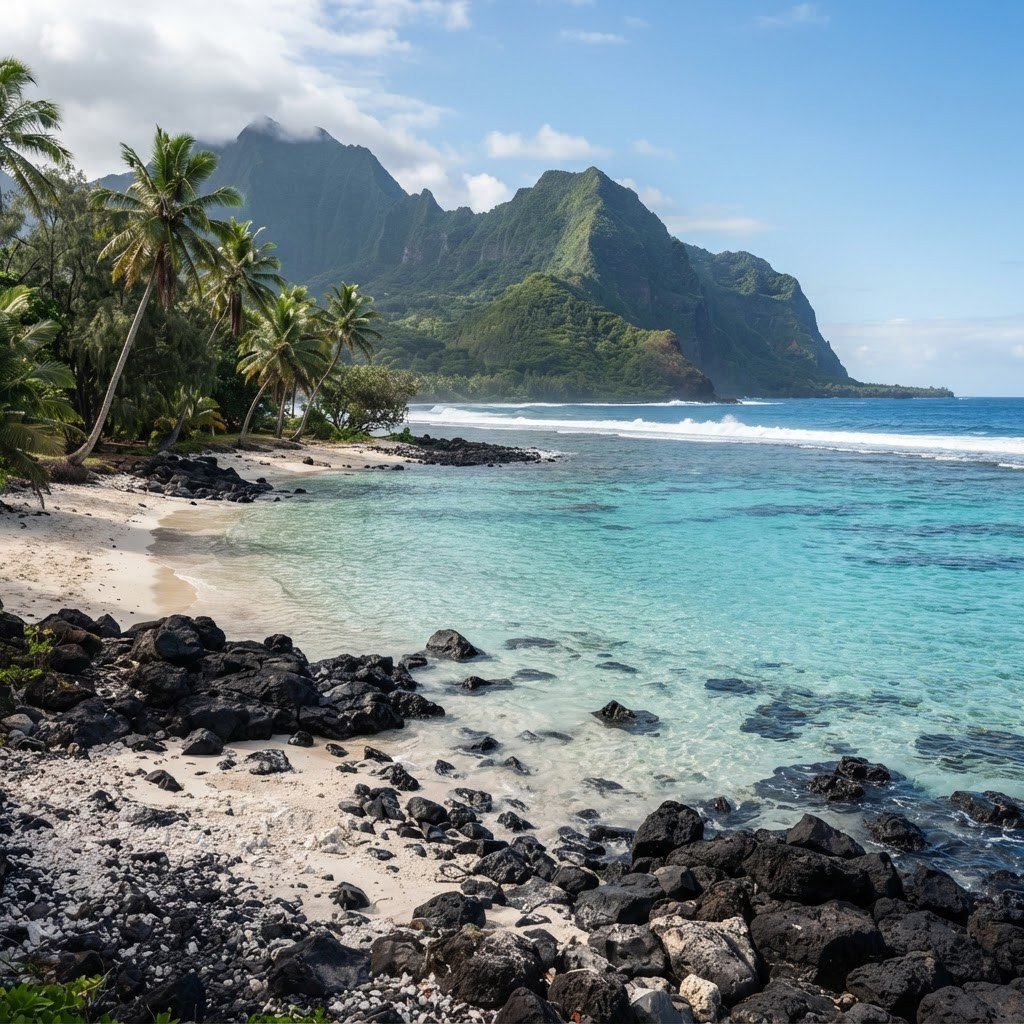
The crowd is a mix of local Réunionnais naturists, mainland French expats (métros), and a trickle of international travelers who did their homework. The southern rocky coves have a long history as a gay gathering area. Standard naturist etiquette holds firmly among regulars: towel down, respect space, absolutely no photography, and quiet voices. The regulars are also the first to report public sexual activity in the surrounding bushes – voyeurism and cruising are the scene’s chronic friction point, and every incident invites police attention the beach cannot afford.
The Legal Status: Tolerated, Not Official – and Technically Banned
Here is Réunion’s central paradox, and it must be stated honestly: Souris Chaude is not an officially designated naturist beach, and the municipality’s own 1978 decree (arrêté municipal) formally prohibits public nudity along its coastline. What protects the beach in practice is a combination of French jurisprudence and enforcement reality.
Under Article 222-32 of the French Penal Code, sexual exhibition in a public space is a criminal offense. But simple, non-sexual public nudity is not a standalone offense under French national law absent sexual intent or public disturbance – a distinction French courts have drawn for decades and one that underpins the entire tradition of naturism in France. For a beach to become officially naturist, the local mayor must issue a decree designating a zone. Les Trois-Bassins has repeatedly refused – citing limited municipal police resources, coastal conservation rules, and public decency concerns.
The result is tolerance de facto: the theoretical €35 municipal fine is essentially never enforced against discreet sunbathers, and gendarmes leave the beach alone so long as nothing sexual or disorderly occurs. The Naturist Federation (FFN) lists Souris Chaude as a customary naturist spot on its maps, but no FFN-affiliated club exists on the island.
The tolerance was not won without a fight. The late Alain Boutet (1947-2010), founder of the Collectif SOS Naturiste, petitioned the Administrative Court of Réunion in 2010 to annul the 1978 decree and force the beach’s legalization. The tribunal rejected the petition in May 2010; Boutet died weeks later. The beach survives on custom and discretion – a fragile legal footing travelers should understand before they go.
Beyond Souris Chaude, a few remote spots – Cap La Houssaye north of Boucan Canot, Pointe au Sel south of Saint-Leu, and the lava-wild Pointe du Tremblet in the deep south – see occasional discreet use. None are official, none are policed, and none offer safe ocean access.
The Shark Crisis: Read This Before You Swim
Réunion has the most dangerous swimming conditions of any destination on this site, and honest coverage demands plain language. Between 2011 and 2019, the island suffered 24 shark attacks, 11 of them fatal, almost all involving bull sharks along the west coast. In response, the Prefect has maintained a standing decree since July 2013: swimming, surfing, and bodyboarding are prohibited island-wide within 300 meters of shore, except inside coral-reef lagoons, net-protected zones, or enclosed natural sea pools.
And here is the critical point for naturists: Souris Chaude has no protective coral reef. The beach opens directly onto deep, powerful open ocean. Open-water swimming there is both illegal under the prefectural decree and genuinely dangerous. The only safe cooling-off at Souris Chaude is the shallow volcanic rock pools along the basalt shelf, which are separated from the open sea – safe, sheltered, and shark-proof at low tide. If you want a proper ocean swim, dress and use the protected zones: the lagoons at L’Ermitage and Saint-Leu, the shark-net beaches at Boucan Canot and Roches Noires, or the enclosed sea pools at L’Étang-Salé and Saint-Philippe. Treat the rules as non-negotiable; locals do.
Practicalities: Getting There and Getting Around
Flights: Réunion is served by Roland Garros Airport (RUN) at Saint-Denis, with daily non-stops of roughly eleven hours from Paris – Air Austral, French bee, and Corsair from Orly, Air France from Charles de Gaulle. Connections from Madagascar, Mauritius, and South Africa also exist. Most North American travelers route through Paris or Johannesburg.
Compare Flights
Flight prices to your destination change constantly. Compare current fares and find the best deal:
Compare flights to Réunion (RUN) →
Affiliate link: we may earn a commission at no cost to you.
Car rental is effectively mandatory. The island’s buses (Car Jaune) run the coastal highway but do not stop anywhere near the Souris Chaude trailhead, and the island’s real attractions – the cirques of Cilaos, Salazie, and Mafate, and the Piton de la Fournaise volcano – require wheels.
Season: Aim for the austral winter, May to October – dry, low-humidity, 24-28°C on the coast, water at 23-25°C, and no cyclone risk. November to April is the cyclone season (Cyclone Belal tore through in January 2024): hot, humid, and wet. Water temps peak at 27-29°C, but the trade-off is not worth it.
Accommodation: There are no naturist resorts or FFN-licensed holiday parks on the island. Naturist travelers book private self-catering gîtes or villas with enclosed gardens and private pools in the sunny west and south – Saint-Gilles, Saint-Leu, Trois-Bassins, L’Étang-Salé – which offer the full French-style private-naturism experience between beach visits.
Réunion in Context
Home to about 880,000 people, Réunion is one of the most culturally hybrid places on Earth – French administration layered over Creole society, with Malagasy, African, Indian, Chinese, and European threads in its population. Locals regard Souris Chaude with the pragmatic shrug of long custom: it has been the island’s “naturist beach” for over four decades, everyone knows where it is, and the live-and-let-live arrangement suits the regulars. In a region where the neighboring islands criminalize the practice outright, that makes this modest volcanic cove something genuinely rare. See Naturism in Africa: The Honest Map for how Réunion fits into the continental picture.
For naturists planning an Indian Ocean trip, the conclusion is simple: Réunion is the only island in the ocean where a naturist beach exists at all – a tolerated anomaly inside France’s legal universe, best enjoyed May to October, with swims confined to the rock pools and respect paid to the fragile tolerance that keeps it alive.
Where to Stay
Find accommodation near the naturist zone below:
Map and booking options are provided through our affiliate partner.
Affiliate & Image Disclosure: This article contains affiliate links (flights and accommodation) that may earn us a commission at no cost to you. Images are AI-generated illustrative visuals, not photographs of the specific location.
Leave a Reply