

Micronesia is the most legally interesting corner of the Pacific for naturists – the region where US territorial law, tiny nations, and hundreds of genuinely uninhabited islands intersect. The verdict splits three ways: Guam and the Northern Marianas are a hard no on military-and-family beach culture; Palau is the charter-friendliest jurisdiction in the Pacific if you do it right; and the scattered atolls of the Marshall Islands and FSM host the purest version of the deserted-island fantasy anywhere on earth.
Guam and the Northern Marianas: The American No
Both are US territories with their own indecent-exposure statutes – Guam Code Title 9 § 28.65 and CNMI Code § 1315-1316 – which criminalize the public exposure of genitals or female breasts where others may be offended. The beaches that dominate visitor life are doubly guarded: Tumon Bay and Saipan’s Micro Beach are family resorts serving East Asian tour groups and patrolled by territorial police, while the military installations – Gab Gab Beach on Naval Base Guam, Tarague on Andersen – enforce their own base rules with military police. There are no official clothing-optional beaches; the rugged remote ledges at Pagat or Saipan’s Forbidden Island that see occasional adventurous use are unregulated and legally risky, not tolerated.
Palau: The Rock Islands Reality
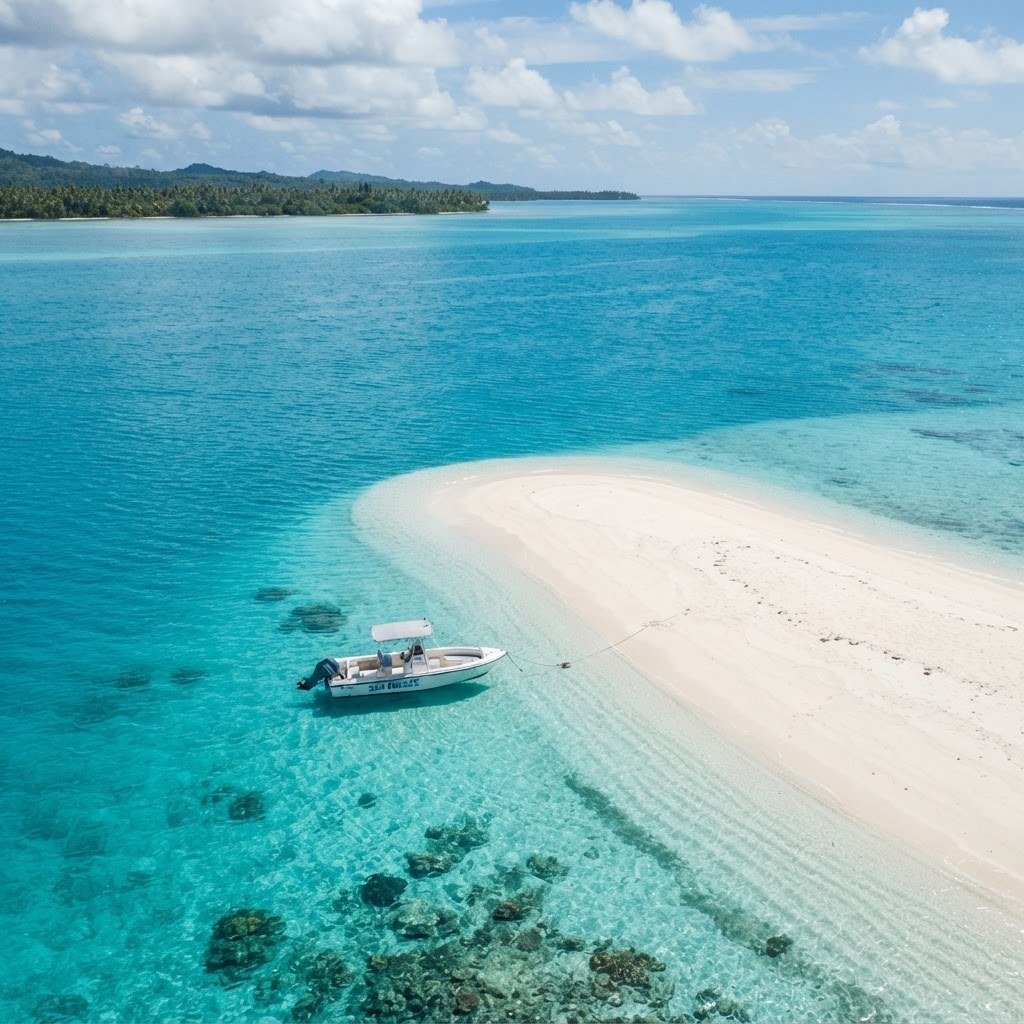
Palau’s Rock Islands Southern Lagoon is a UNESCO World Heritage site of two to three hundred uninhabited limestone islands – and the honest answer about naturism there is a two-tier one. Shared tour boats to Jellyfish Lake and Milky Way require standard swimwear, and no commercial clothing-optional charter exists. But a privately chartered boat out of Koror, with the Palauan captain negotiated with upfront and a course set for an isolated cove away from the tour channels, achieves de facto unclothed swimming and sunbathing on genuinely empty sand. The same logic applies to Palau’s liveaboard dive fleet: nude sunbathing on the top deck while anchored in a remote cove is feasible when cleared with the captain and crew. Palau is the rare jurisdiction where the deserted-island question has a workable, respectful answer.
Yap: The Cultural Nuance Worth Understanding
Yap holds the Pacific’s most fascinating cultural nuance: in traditional Yapese society, breasts were never erotic body parts. Modesty focused on the upper thighs and buttocks, women wore woven hibiscus skirts and went topless, and to this day Yapese dancers and elders wear traditional topless attire at cultural celebrations like Yap Day. The crucial distinction for visitors: this exemption is for Yapese custom, not for foreign tourists. Foreign women going topless on Yapese beaches or in villages read as disrespectful, not as cultural fluency. It is the clearest example in the world of a naturism question that is not about law at all, but about whose culture sets the terms.
The rest of FSM – Chuuk, Pohnpei, Kosrae – is conservative missionary-standard; the Marshall Islands add hundreds of unpopulated motus on outer atolls like Arno, Jaluit and Mili, reachable only by chartered boat with full self-sufficiency. And Nauru scores the lowest possible: a single 21-square-kilometer island, one ring road, eleven thousand residents, no lagoon, no islets, no privacy geometry at all.
The Legal Theory: No Viewer, No Crime
Here is the deserted-island question answered with actual legal doctrine. Indecent-exposure statutes across Micronesia – Guam’s § 28.65, CNMI’s § 1315, Palau’s 17 PNCA § 1609 – share three elements: a public place or public view, the presence of unconsenting persons likely to be offended, and intent to affront or arouse. On a genuinely uninhabited islet reached by private charter, all three fail: no public view, no complainant, no sexual intent. That is the practical grey zone, and its three caveats are what keep it grey. First, your crew is the public: exposure without prior consent is exactly the offense the statutes describe, and word travels back to port. Second, conservation and permit rules still bind – Rock Islands entry permits, protected areas, nesting seasons. Third, customary land tenure: some islets are state-protected, others are customary family property, and the difference is invisible from the water. Charter smart, consent first, and the theory holds; improvise, and it collapses.
Practical Notes and the Verdict
- Getting there: Koror (ROR) is the Palau gateway – most visitors route via Guam or Manila; Pohnpei and Yap via Guam; Majuro via Honolulu.
- Season: Palau is diveable year-round; the western Pacific typhoon season runs roughly June to November.
- Permits: the Rock Islands Southern Lagoon requires a permit purchased in Koror – factor it into any charter plan.
The verdict: Micronesia is the Pacific’s charter-naturist frontier. Guam and Saipan are a definitive no, Yap is a culture to respect rather than a loophole to use, and Palau – with a captain’s consent and an empty cove – is the closest thing left on earth to the classic deserted-island naturist day. See also the Melanesia guide and the Independent Polynesia guide, and the French contrast in our Overseas France guide.
Find a place to stay
Map and flight search via our affiliate partner Stay22 – we may earn a commission on bookings.
Koror (ROR) is the Palau gateway, via Guam or Manila. Compare fares via Kayak
Leave a Reply