Naturism in Israel: Ga’ash Beach, the Dead Sea and Midburn’s Naked Desert City
Israel presents the naturist traveler with one of the world’s great paradoxes: a socially conservative country that has never once legally designated a nude beach – yet home to a beach where people have sunbathed naked for half a century, a national naturist federation, mass nude art installations on the Dead Sea, and the second-largest Burning Man regional festival on Earth. Nothing here is official. Everything here works anyway, on pragmatic tolerance – and understanding that tension is the key to naturist travel in Israel.
The Legal Reality
Israeli law never names simple nudity as a crime. The relevant statute is Section 349 of the Penal Law, 5737-1977 – “an indecent act in public” before an unconsenting person. Because plain, non-sexual nude sunbathing rarely meets that threshold, enforcement at Israel’s recognized unofficial spots is famously pragmatic: police look away unless there are complaints of overt sexual acts, harassment or voyeurism. It’s the same legal architecture as many European countries – what’s missing is the European follow-through of official designation. Israel tried that once, and it failed: a 2011-2012 Tel Aviv city council proposal (introduced by then-councilmember Tamar Zandberg) to designate a legal nude beach on the northern coastline was shelved under religious and conservative opposition. The result: Israel’s naturism exists entirely in the tolerated-but-unofficial register.
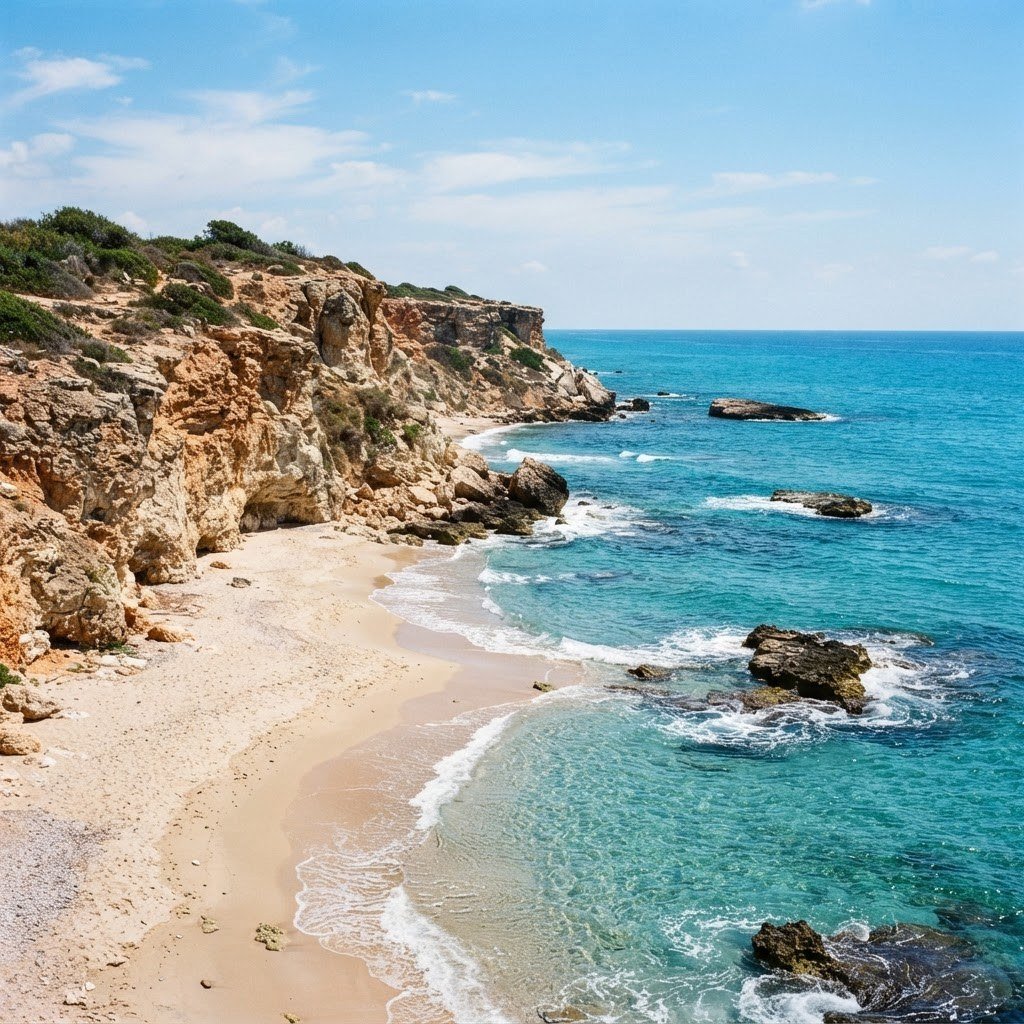
Ga’ash: fifty years of tolerance below the cliffs.
Ga’ash Beach: Fifty Years of Tolerance
About 20 km north of Tel Aviv, below the sandstone cliffs near Kibbutz Ga’ash, lies Israel’s oldest and most famous nude beach – a clothing-optional tradition dating to the 1960s and 70s. One myth needs clearing up: you’ll sometimes read that Ga’ash was “declared Israel’s first official legal nude beach.” It wasn’t. No Israeli authority has ever designated it; its status is pure tolerance. There are no lifeguards or facilities – you reach it by descending narrow dirt trails down the cliffs near Kibbutz Ga’ash/Shefayim, or by walking the shoreline north from Sidna Ali (Herzliya) or south from Poleg. The crowd is a genuine cross-section – mixed families and naturists on the central and northern stretches, a prominent gay crowd toward the south. Arrive on a summer weekend and you’ll find a well-established, self-regulating community that treats the rules as sacred: no photography, no staring, no trouble.
The same tolerance covers a string of quieter coastal pockets: the southern stretch of Poleg Beach near Netanya, the dunes south of Palmachim, remote sections of the Habonim reserve and the Beit Yanai coast near the Alexander River estuary, and isolated cliff-base stretches south of Netanya. All unofficial, all governed by discretion.
The Dead Sea: Floating Naked – and a Territory Note
The Dead Sea is the naturist fantasy destination – float weightless in mineral water, smear yourself in black mud, with nothing between you and the desert. The geography matters for honesty: the southern basin beaches at Ein Bokek and Neve Zohar sit in sovereign, pre-1967 Israel, while the historic naturist-favored northern shore – Metsoke Dragot, Kalya Beach, Neve Midbar and the former Mineral Beach – lies in the West Bank (Area C), Israeli-administered territory whose status is disputed under international law. It was at Mineral Beach, in September 2011, that artist Spencer Tunick photographed ~1,200 naked Israelis floating in the water – the largest nude installation Israel has ever seen, staged as an ecological protest. (He returned in October 2021 near Arad, inside Israel proper, with ~200 participants painted white.)
Practical warning that outranks the politics: the Dead Sea is shrinking fast, and its retreating shoreline has spawned thousands of sinkholes that have destroyed or closed much of the wild beachfront – Mineral Beach itself was swept away in a 2014 flood after sinkholes made it unviable. Floating nude here is still possible, but it now happens at the developed beaches or with real care about where you walk.
The Israeli Naturist Society
Israel’s organized scene is small but genuinely national. The Israeli Naturist Society (Ha-Amuta Ha-Israelit Le-Naturism), founded in the summer of 2000, is the International Naturist Federation’s Israeli member federation. It organizes the private-venue heart of Israeli naturism – clothing-optional pool evenings, spa days, and desert camping trips – since Israeli commercial spas and hotel saunas are strictly swimsuit-required, unlike the German or Nordic worlds. The beach provides the public face; the society provides the community infrastructure.
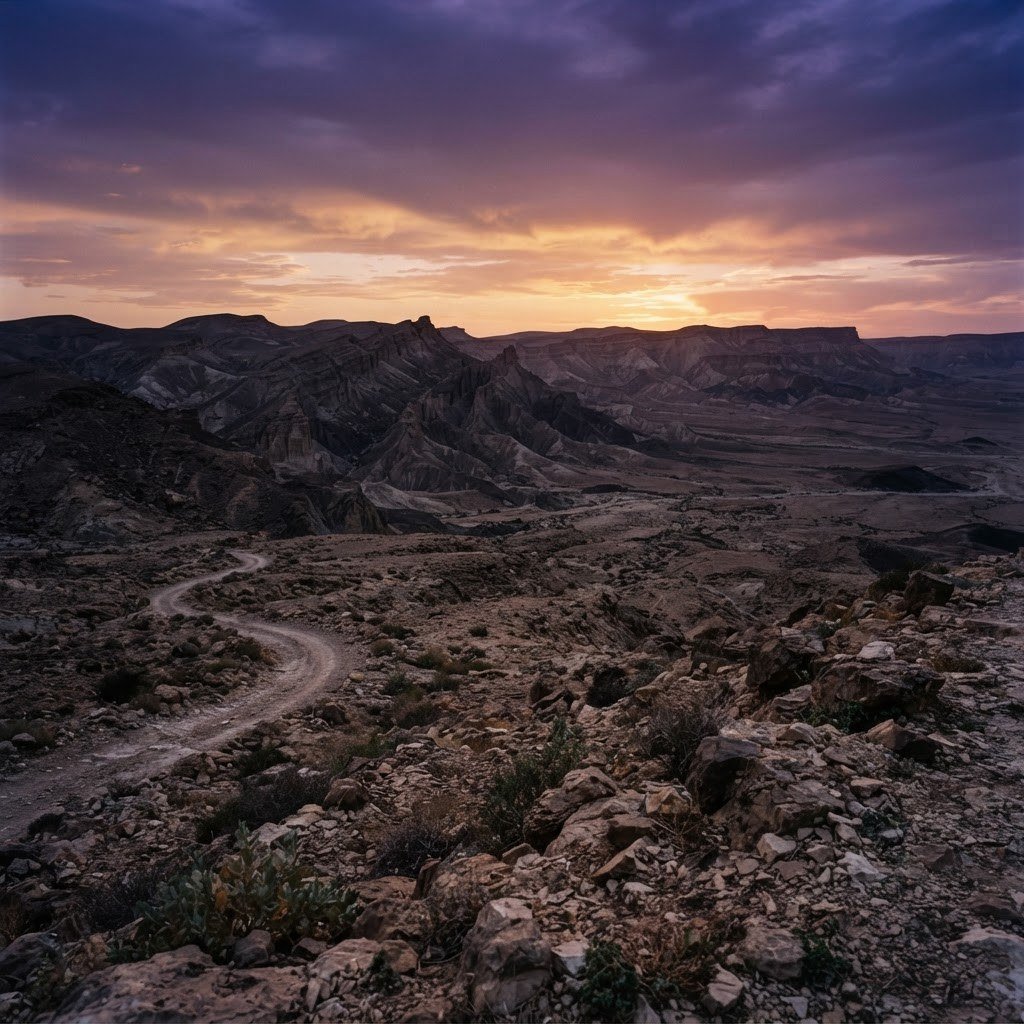
The Negev: 8,000 years of desert ritual, and now a naked city for one week a year.
Midburn: The Negev’s Naked Desert City
For one week in late spring, the deepest answer to “where can I be naked in Israel?” is a temporary city in the desert. Midburn, Israel’s regional Burning Man, was first held June 3-7, 2014 near Sde Boker in the Ramat HaNegev, founded by Israelis returning from the Nevada event. It grew explosively – from ~3,000 participants in 2014 to 10,000-12,000 at its 2017-18 peak, making it the second-largest Burning Man regional in the world after South Africa’s AfrikaBurn. Nudity there is clothing-optional self-expression under Burning Man’s principles, concentrated in the body-painting, yoga and shower camps. The event’s relationship with Israeli law is itself instructive: in 2015, police tried to block the permit days before opening, citing nudity among other concerns – and the Beersheba District Court overturned the ban, while requiring organizers to keep nudity out of sight of the perimeter and minors. In 2019 the event was canceled when the IDF refused the proposed site inside a live-fire training zone; recent editions have continued under tight environmental caps. Timing is around Shavuot/Lag BaOmer – late May or early June.
The Pagan Question: An Honest Answer
Is a naked festival in this particular desert echoing ancient rites? The honest answer is: no lineage, but real resonance. Burning Man’s founders, and the scholars who study it (Lee Gilmore’s Theater in a Crowded Fire is the standard work), describe it as an invented, post-secular ritual – modern neo-pagan aesthetics without pagan descent. Yet the Negev genuinely is one of the world’s richest archives of ancient desert body-and-fertility cults. Archaeologist Uzi Avner has documented more than 100 Neolithic and Chalcolithic open-air cult sites (~6000-3000 BCE) across the Negev and Sinai, with phallic standing stones and vulva-shaped rock installations – 8,000-year-old evidence of ecstatic desert ritual. At Kuntillet Ajrud, on the Negev-Sinai borderlands, 8th-century BCE inscriptions invoke “Yahweh of Samaria and his Asherah” – the goddess worshipped alongside the Israelite god on this exact desert frontier. The Nabataeans kept cult high-places at Avdat, Shivta and Mamshit into the Roman era. So: Midburn did not continue an ancient tradition, but it pitches its tents on ground where humans have been holding body-and-fire rituals for eight millennia. As thematic echoes go, that one is worth savoring on the playa at dawn.
Planning the Trip
Getting there: Ben Gurion Airport (TLV); Ga’ash is 25-30 minutes north of Tel Aviv by car (train or bus to Herzliya or Netanya plus a short taxi ride).
Season: beach season runs May-October, June-September is the sweet spot; Midburn requires buying a ticket (they sell out fast) in the late-May/June window.
Etiquette: the tolerated status of every spot depends on the community’s discretion – no photos, no staring, and keep to the recognized stretches.
The itinerary that works: Tel Aviv as base, Ga’ash for the beach days, a Dead Sea float (developed southern beaches for reliability), and Midburn if your dates align – the only place in the Middle East where tens of thousands of people gather under a radical self-expression banner.
Flying in? Ben Gurion (TLV) is the single international gateway. Search and compare fares on Kayak. Disclosure: affiliate link – if you book through it, we may earn a commission at no extra cost to you.
Where to Stay
Base yourself in Herzliya or northern Tel Aviv to be closest to Ga’ash – anywhere along the coast works, since Israel is compact. The map below is centered on the Ga’ash beach area:
Disclosure: this map contains affiliate booking links. If you book through it, we may earn a commission at no extra cost to you.

Leave a Reply