
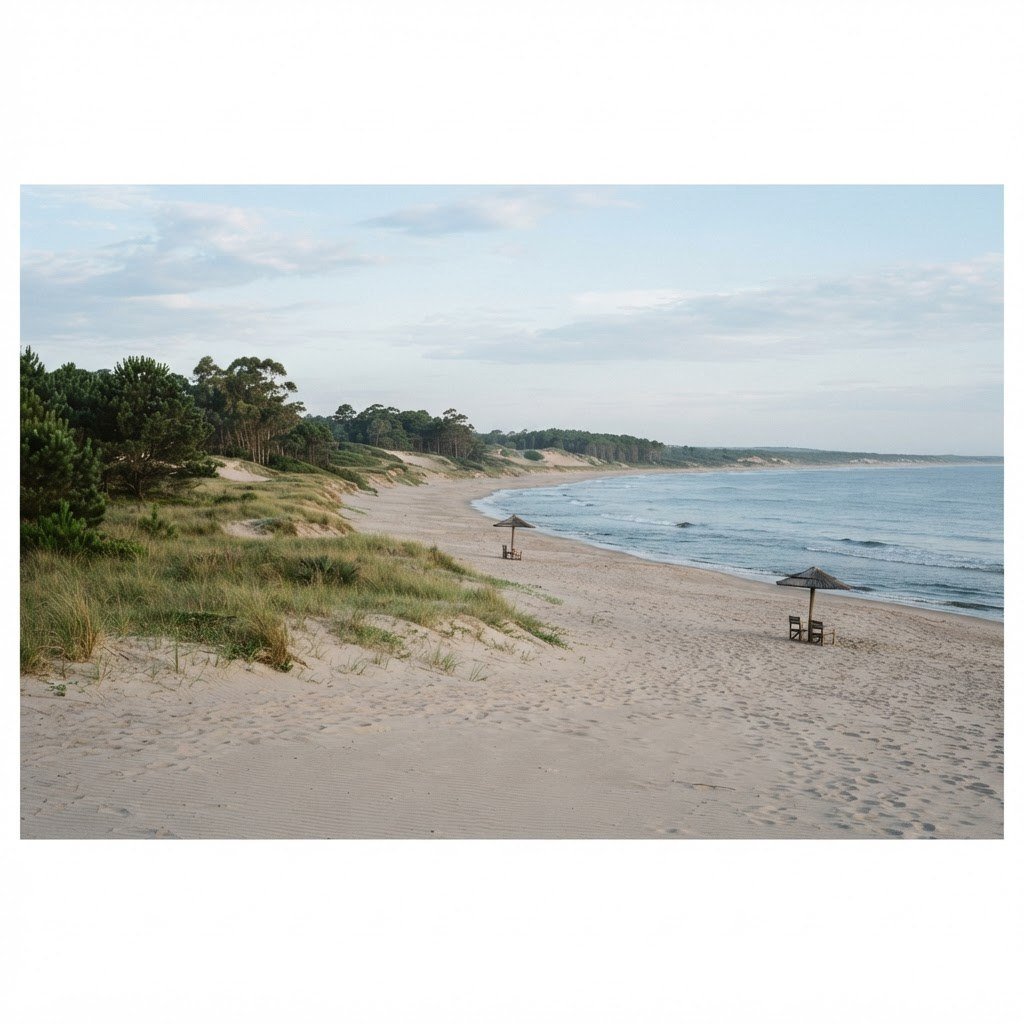
Uruguay holds a title no other country in the Southern Cone can claim: in 2000, the Maldonado department government formally decreed Playa Chihuahua an official naturist beach, making it the first officially recognized nude beach in the region – decades after bohemians discovered it, and years before most of South America would tolerate one at all. Today, a short drive from Punta del Este, sits a two-kilometer stretch of Atlantic sand with lifeguards, beach bars, clothing-optional hotels, and the full backing of municipal law. This is the complete guide – including the true story of the name.
Playa Chihuahua: The Official Zone
The beach curves along the Bahía de Portezuelo, about fifteen kilometers west of downtown Punta del Este, roughly two kilometers of coastline running east from the mouth of Arroyo El Potrero. Access is via Ruta 10 near kilometer 115.5, down an unpaved sand track through pine dunes and a short walk over the dune belt – pedestrians can also walk the shoreline from Portezuelo or wade the stream when it’s low. The naturist zone’s exact boundaries were codified by municipal resolutions in 2012, running from the stream east along the bay, with the dune ridge as the northern edge.
What sets Chihuahua apart in the Americas is the infrastructure. This is not a tolerated stretch of nowhere: a municipal lifeguard tower operates daily through peak summer, paradores serve seafood and drinks with umbrella and chair rentals on the sand, and three clothing-optional hotels sit directly behind the beach – Hotel El Refugio, the gay-exclusive Undarius, and Hotel Chihuahua Resort. The crowd is the most body-positive in South America: local Uruguayan regulars, Argentine and Brazilian visitors, European snowbirds, LGBTQ+ travelers, couples, and solos, with an average age range that actually looks like real life.
Why Is It Called Chihuahua? The Real Answer
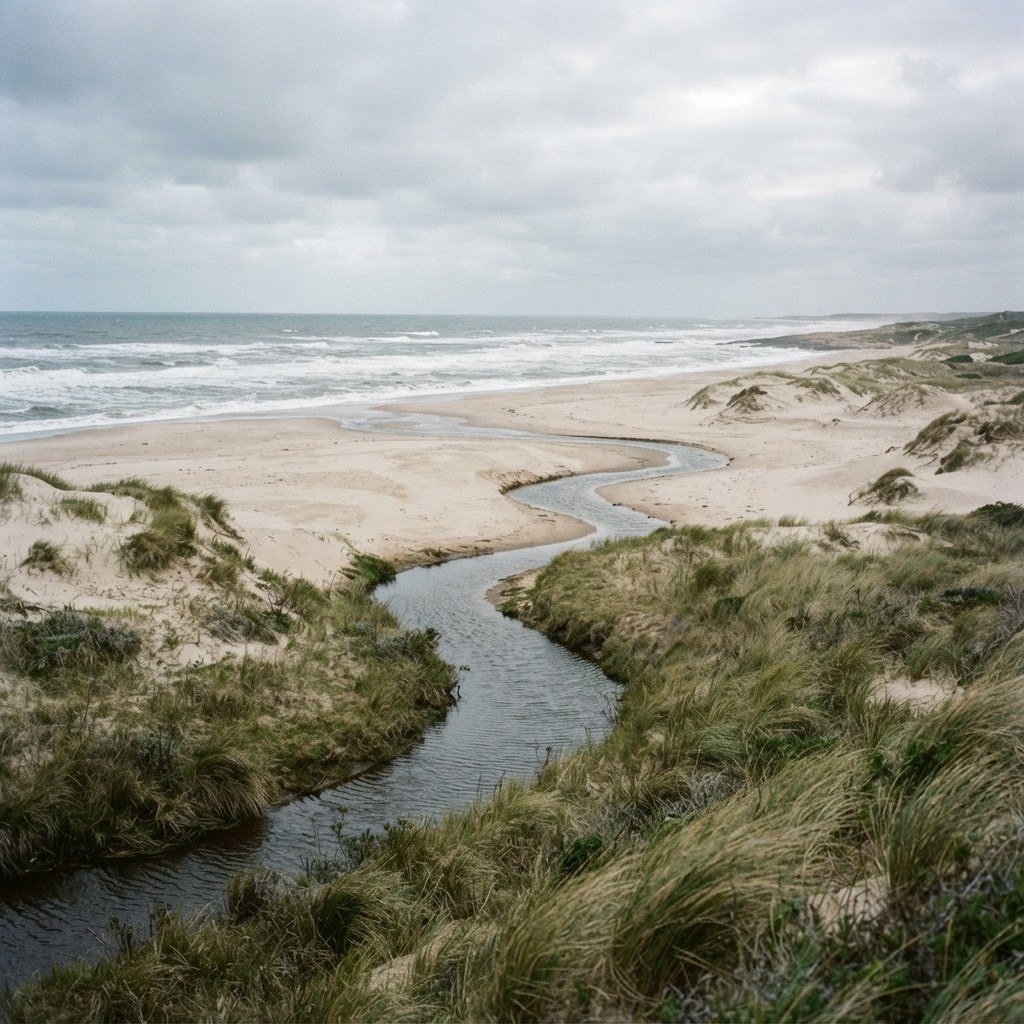
The most common legend – that a settler’s tiny pet dog gave the beach its name – is charming, and it is not true. The name comes from Arroyo Chihuahua, the small local stream and wetland connected to Arroyo El Potrero, which gave its name to the mid-twentieth-century land subdivision (the fraccionamiento Chihuahua) documented in the area’s official cartography. Local historians confirm the dog story as folklore. In the 1960s bohemian era the beach was briefly nicknamed “Playa Luna,” but the official toponymy won – and so Texas-dog breed or not, the name on the map is the one that stuck.
The Law: Why Uruguay Works
Uruguay’s Penal Code (Article 277, ultraje público al pudor) criminalizes obscene acts in public – and under Uruguayan jurisprudence, simple non-sexual nudity in an established context is not an obscene act. Enforcement against naturists at the recognized beach is non-existent by policy. Two further facts define the coast: topless sunbathing is broadly accepted on all Uruguayan Atlantic beaches, not just Chihuahua, and full nudity outside the zone draws, at most, a polite request from police if someone complains – not arrest. It is the most relaxed legal environment for naturism on the continent, and it shows in the beach’s unbothered atmosphere.
Beyond Chihuahua: The Rocha Coast
The scene doesn’t end at the official zone. East along the wild Rocha coast, the off-grid bohemian settlements carry a tolerated tradition: at Cabo Polonio, the remote sands toward the great dunes see widely tolerated clothing-optional use, and at Punta del Diablo, the far ends of Playa Grande and Playa de la Viuda host informal naturist sunbathing. These are hippie-coast spots – no infrastructure, no decree, and discretion still the rule – but they extend Uruguay’s permissive streak a hundred kilometers further. Closer to Punta del Este, Playa de los Ingleses at the peninsula’s tip is a topless-tolerated rocky sunbathing spot, not a nude beach.
The Scene: AUNNA
The organized voice is AUNNA, the Uruguayan naturist association, founded on June 6, 2009 at an assembly held at Hotel El Refugio on the beach itself. AUNNA is Uruguay’s INF-FNI correspondent, promotes dune conservation and beach ethics, and participates in the Encuentro Latinoamericano de Naturismo – putting Uruguay alongside Brazil and Argentina as one of the three anchors of Latin American naturism.
Practical Notes
- Getting there: The beach is 2.5 km from Punta del Este’s airport (PDP) and a fifteen-minute drive from downtown; buses stop at the Laguna del Sauce junction, and the airport is walking-bike distance from the sand.
- Season: November through March, peak December-February – 25-32°C air, 20-24°C water. Shoulder months (November, March) mean emptier sand.
- Etiquette: The towel rule applies, photography of others is strictly forbidden, sexual behavior ends the tolerance instantly, and the dunes and stream are protected ecosystems – pack out everything.
For the neighboring maps: our Argentina guide, Brazil guide, and Chile guide complete the Southern Cone.
Compare Flights
Punta del Este (PDP) is 2.5 km from the beach; Montevideo (MVD) is the backup gateway. Compare current fares:
Affiliate link: we may earn a commission at no cost to you.
Where to Stay
Find accommodation around Bahia de Portezuelo and Punta del Este below:
Disclosure: this map contains affiliate booking links. If you book through it, we may earn a commission at no extra cost to you.
Leave a Reply