
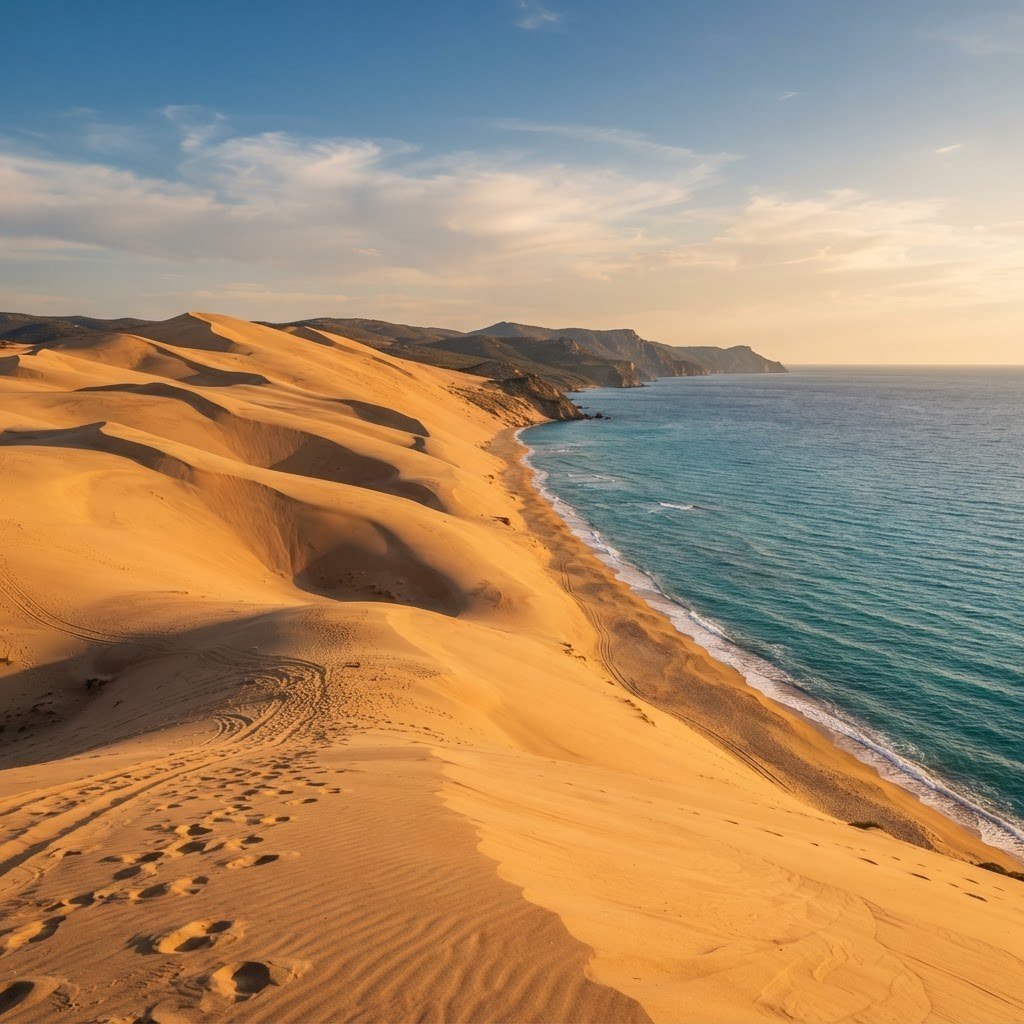
Sardinia is the most advanced naturist island in the Mediterranean, and it has the paperwork to prove it: in 2017 it became the first Italian region to write naturist tourism directly into law – Regional Law 16/2017, Article 36 – which gives every municipality the power to formally designate naturist beach zones with official signage, and created the “Rete Naturista Sarda,” the Sardinian naturist network. The result is a two-tier island: an official tier of five designated FKK beaches concentrated on the west and south coasts, and a zero-tolerance tier on the Emerald Coast and the boat-crowded east. Know which tier you are standing on, and Sardinia becomes one of Europe’s great naturist destinations.
Porto Ferro: The First Official Beach
In May 2018, the Municipality of Sassari designated Porto Ferro as Sardinia’s first official FKK beach, under the new regional law. The setting is the island’s northwest: a red-gold sandy bay backed by pines near the Lake Baratz end and the Torre Bianca, with official municipal signage and Blue Flag water, just 15-20 minutes from Alghero’s airport. For a quick, legally secure naturist weekend, Porto Ferro is hard to beat – fly into Alghero, and you can be on an officially signposted nude beach within half an hour of landing.
Piscinas: The Dunes
Then there is Piscinas, on the Costa Verde – arguably the most spectacular official naturist beach in Italy. In August 2018 the Municipality of Arbus (Delibera 125) dedicated an 800-meter stretch of beach beneath some of the tallest sand dunes in Europe – a miniature Sahara rolling down to a turquoise sea, with a naturist tradition dating to the 1970s. It is remote, elemental, and bucket-list material: among the largest officially designated FKK beaches anywhere on the continent.
The Rest of the Official Map
The decree map grew fast. In May 2022, San Vero Milis designated Is Benas, golden dunes on the Sinis peninsula, as the third official FKK beach. Weeks later, Muravera passed Delibera 27/2022 designating Feraxi – the first official naturist beach on the east coast, a 400-600 meter stretch of wide golden sand. And on the Ogliastra coast, the Municipality of Bari Sardo set aside a 200-meter sector at Sa Marina in its official beach-use plan. Two tolerated names complete the list: the far southern end of Porto Pino, with decades of customary use but no formal designation, and the dune section past the windsurf zone at Serrato/Porto Liscia near Santa Teresa Gallura – the escape valve for visitors staying on the textile Emerald Coast.
The Myth-Bust List
Sardinia’s fame has generated a remarkable amount of nonsense on international travel blogs, so the honest guide needs a cleanup list. Is Canaleddu near Cagliari is not a naturist beach – it is a narrow, eroded pebble strip confused with Is Benas in online copy-paste. Cala Violina does not exist in Sardinia at all – it is in Maremma, Tuscany, a geographical blunder repeated on amateur sites for years. Cala Corsara in the La Maddalena National Park and Capriccioli on the Costa Smeralda are pure myths: heavily patrolled, boat-crowded, zero tolerance. The Costa Smeralda itself is an absolute public naturism zero – private villa coves and yacht anchorage only. And the postcard coves of the Gulf of Orosei – Cala Luna, Cala Sisine, Cala Mariolu – are summer boat-traffic icons where naturism is impossible in peak season; discreet use happens only in the shoulder months by private boat or the Selvaggio Blu trail.
Culture: The Harmony Formula
Sardinia is deeply Catholic, family-centric, and protective of public modesty – and it is also the Italian region most comfortable with official naturism. The reconciliation is what might be called the harmony formula: Sardinians respect law above all, so where a beach carries municipal signage, acceptance follows without friction. Locals and tourists coexist easily at Porto Ferro, Piscinas, Feraxi and Sa Marina; the sharp social hostility – and the real administrative fines of 5,000 to 10,000 euros under the decriminalized national decency statute – is reserved for nudity on non-designated family beaches.
Practical Notes
- Getting there: Alghero (AHO) is 15-20 minutes from Porto Ferro – the fastest official-beach transfer in Italy. Cagliari (CAG) serves Piscinas (75 min), Feraxi (60 min) and Porto Pino. Olbia (OLB) serves the Emerald Coast – for naturism, drive 50 minutes west to Serrato/Porto Liscia.
- Car essential: the official zones are dune and dirt-road country.
- Season: May-June and September-early October are ideal; in July-August, stick strictly to the official zones, where space is legally protected even at peak.
See also the Sicily guide for the custom-based model, and the Italy umbrella guide for the national legal framework.
Alghero (AHO) for Porto Ferro, Cagliari (CAG) for the dunes. Compare fares on Kayak (affiliate link).

Leave a Reply