
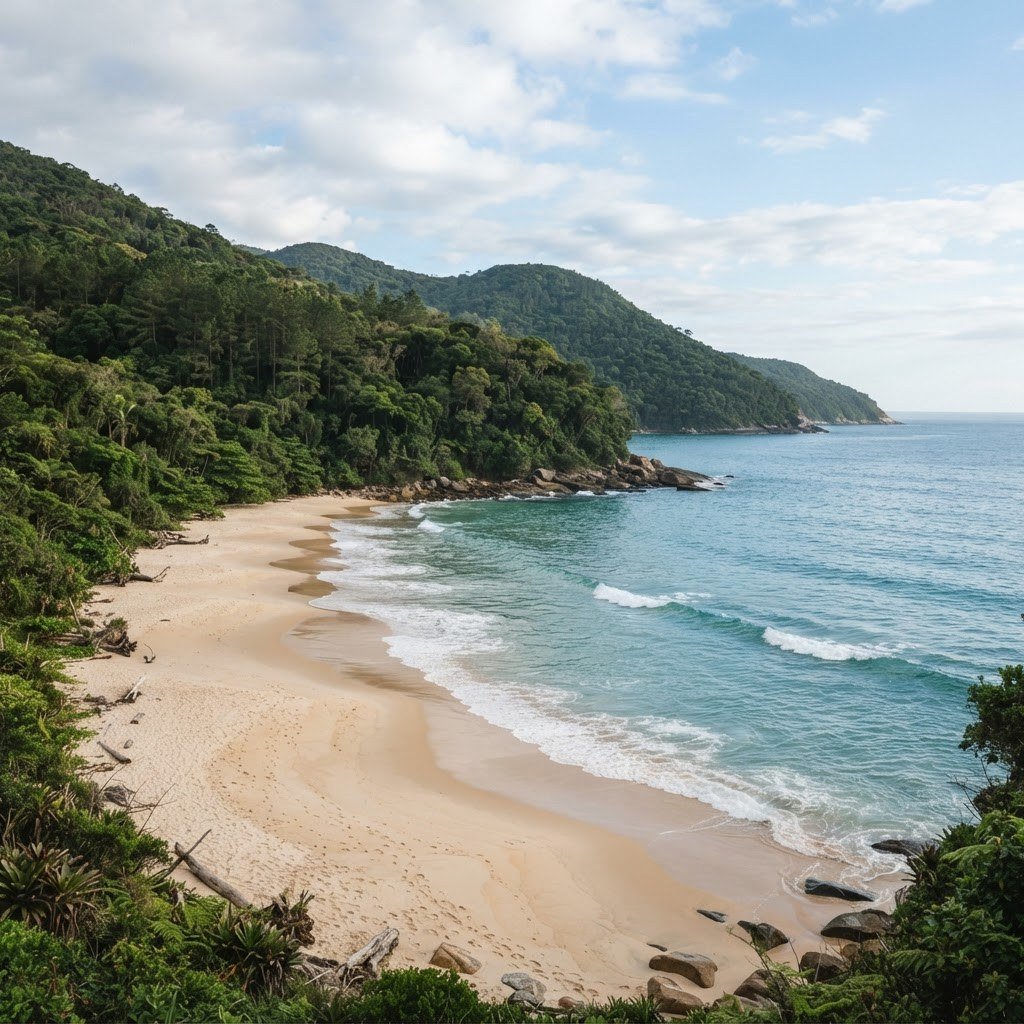
Every organized naturist scene has a birthplace. In Brazil, it is Praia do Pinho – the cove where four friends from the country’s south planted a flag in 1984, fought off landowners to keep the path open, and convinced a city council to write naturism into municipal law for the first time in the country’s history.
The 1984 Founding and the Fence Battle
In 1984, gaúcho Celso Rossi, together with Rose Espíndola, Paula Andreazza and Sérgio Oliveira, began gathering on the then-remote cove south of Balneário Camboriú. The reaction was immediate: local landowners and conservative opponents fenced off the dirt trail and tried to close public access to the beach altogether. Under Brazilian coastal law every shoreline is public land, and the naturists fought the closures on those grounds – and won. They formalized as the AssociaPinho (Associação de Banhistas do Pinho) in 1987-88, and in 1988 the municipality recognized Pinho as Brazil’s first official naturist beach, later codified as Municipal Law 1.050/1990.
That victory launched the entire Brazilian model – the municipal-designation mechanism that has since created seven more official beaches across the country.
The Beach Today
Praia do Pinho sits on the scenic Rodovia Interpraias (the Linha Verde), between Taquaras/Taquarinhas to the north and Praia do Estaleiro to the south. It is a fully serviced naturist beach by Brazilian standards: the association operates camping and a restaurant, and the naturist perimeter is actively managed.
What surprises many first-time foreign visitors is how regulated it is. The beach is explicitly divided into sectors: a couples-and-families sector, a single-women sector, and a single-men sector. Unaccompanied men face strict entry protocols – designated zones only, or admission with a valid FBrN/INF naturist passport or prior accreditation. The policy, designed to protect privacy and families, is genuinely controversial among solo male travelers, and honesty requires saying so: plan ahead or travel with a partner. Gay naturists visit the beach regularly, particularly around the rocky peripheral coves.
Getting There
- By air: Navegantes Airport (NVG) is 33 km north, about 40 minutes by car; Florianópolis (FLN) is 90 km south, about 1 hour 15 minutes.
- By road: From Balneário Camboriú, follow the Interpraias (Linha Verde) south past Taquaras; the access and parking serve the trail down to the cove.
- Season: The southern summer (December-March) is peak season; Santa Catarina’s water is refreshingly cool compared with the tropical Northeast.
Also in Santa Catarina
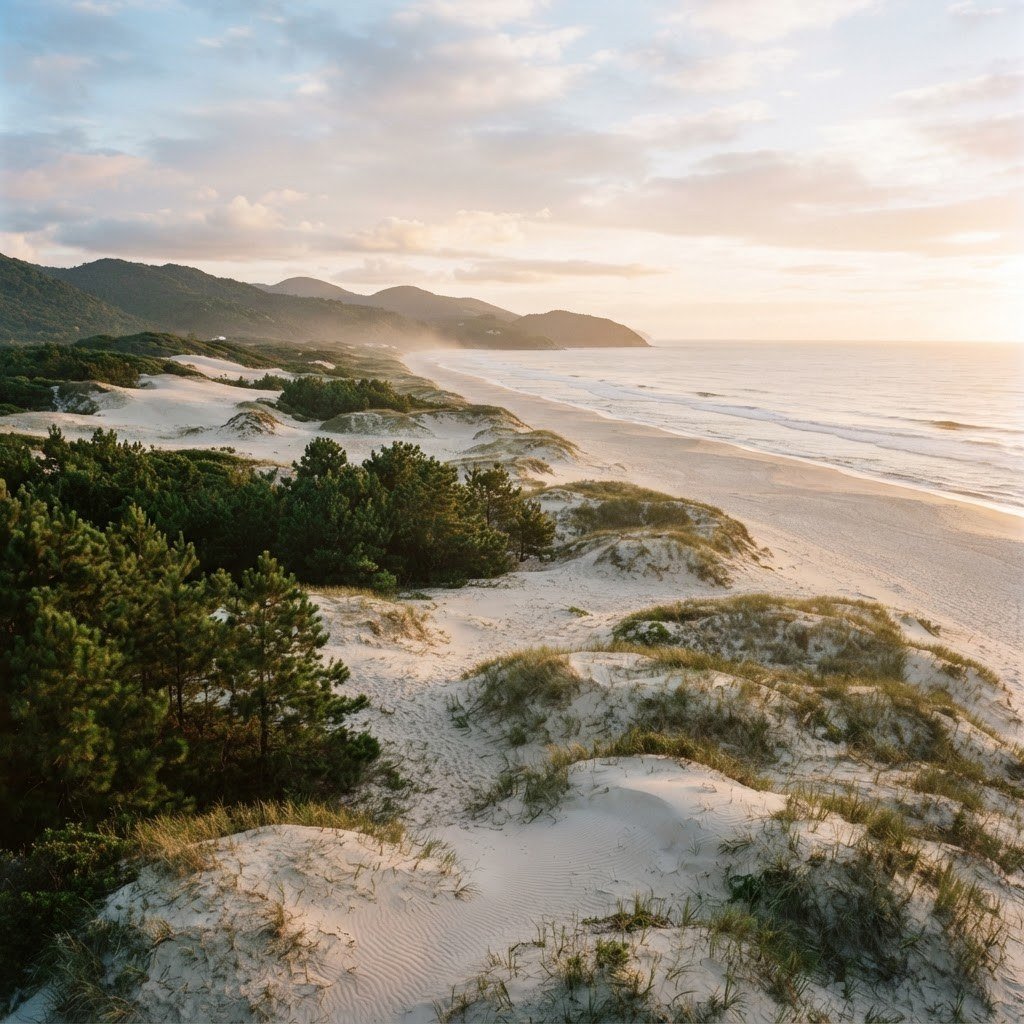
The state is Brazil’s naturist heartland. Praia da Galheta in Florianópolis – a beautiful dune-flanked beach inside its own state park – has been clothing-optional since Law 4.604/1997, though a 2016 municipal amendment removed explicit naturist references and left it as a traditionally tolerated beach. Pedras Altas in Palhoça combines a naturist-recognized beach with an oceanfront naturist resort. Both make Santa Catarina the only place on earth where a state trip can chain together three naturist destinations.
For the full national picture, see Brazil’s official naturist beaches.
Compare Flights
Flight prices to Brazil change constantly. Compare current fares and find the best deal:
Compare flights to Santa Catarina →
Affiliate link: we may earn a commission at no cost to you.
Where to Stay
Find accommodation near the naturist zone below:
Affiliate disclosure: this map and its booking options contain affiliate links; we may earn a commission at no extra cost to you.
Affiliate & Image Disclosure: This article contains affiliate links (marked as such), which may earn us a commission at no cost to you. All images are AI-generated for illustrative purposes and do not depict real people or exact locations.
Leave a Reply